
Description
Product Overview
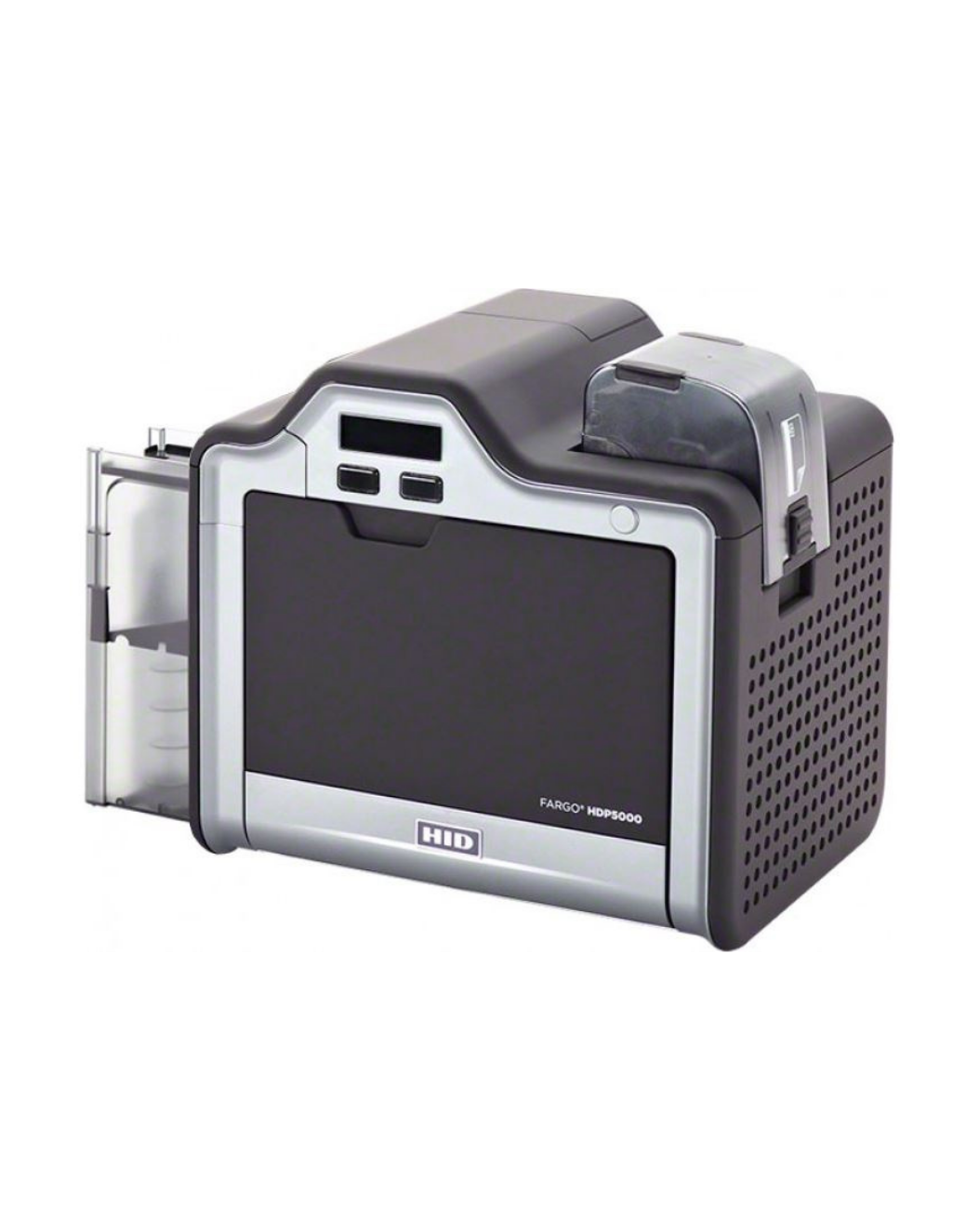
The dual-sided HDP5000e is the configuration most organisations actually deploy, because a secure credential rarely fits on one face. Photo, name and role go on the front; policy text, a barcode, a magnetic stripe panel and issuer contact details go on the back – all printed over the edge with no white margin on either side.
It carries every advantage of the retransfer process. Cards with embedded chips print cleanly on both faces. Card materials beyond standard PVC – polycarbonate, PET, PETG, ABS – are fully supported. And the printed image sits under a bonded film rather than on the card surface, so it resists the abrasion that fades direct-to-card credentials worn daily on a lanyard.
Where this model earns its price is lamination. The dual-side simultaneous module applies overlaminate to both faces in one operation, producing a card that is genuinely difficult to alter – the standard expectation for government identity documents, hospital staff credentials and university cards that double as payment or access tokens.
Set against the AED 7,400 single-sided model, the AED 1,300 difference buys automatic two-sided production. For any issuer printing more than a handful of cards, that pays for itself in operator time alone.
Specifications
| Print sides | Dual-sided, automatic |
|---|---|
| Print speed | More than 130 dual-sided full-colour cards per hour |
| Print method | HDP retransfer – dye sublimation / resin thermal transfer |
| Resolution | 300 dpi (11.8 dots/mm) |
| Print area | Over-the-edge on CR-80 |
| Card size | CR-80 (85.7 × 54 mm) |
| Card thickness | 30-50 mil |
| Card materials | ABS, laminated PVC, PET, PETG, proximity, smart and magnetic stripe cards |
| Input hopper | 100 cards (30 mil); upgrades available |
| Output hopper | 200 cards (30 mil) |
| Interfaces | USB 2.0 high speed; Ethernet with internal print server |
| Memory | 1 GB RAM |
| Display | Graphical OLED |
| Encoding options | Magnetic stripe; OMNIKEY contactless; contact smart card (field upgradable) |
| Lamination | Optional single or dual-side simultaneous modules; PolyGuard overlaminates |
| Power | 100-240 VAC, 1.6 A, 50/60 Hz |
| Operating systems | Windows 10 / 11 / Server 2016 / 2019 / 2022; Linux |
| Warranty | Printer 4 years; printhead lifetime |
FARGO Model Comparison
| Specification | DTC1250e | DTC4500e | HDP5000e | HDP6600 |
|---|---|---|---|---|
| Technology | Direct-to-card | Direct-to-card | Retransfer | Retransfer |
| Resolution | 300 dpi | 300 dpi | 300 dpi | 600 dpi |
| Colour speed | 225 cards/hr | 225 cards/hr | 133 cards/hr | 230 cards/hr |
| Edge-to-edge print | Small white border | Small white border | Over-the-edge | Over-the-edge |
| Card thickness | 9-40 mil | 9-40 mil | 30-50 mil | 30-40 mil |
| Input hopper | 100 cards | 200 cards | 100 cards | 100 cards |
| Output hopper | 30 cards | 100 cards | 200 cards | 200 cards |
| Lamination | Not available | Optional | Optional module | Wasteless lamination |
| Smart-card printing | Not recommended | Supported | Excellent | Excellent |
| Printer warranty | 3 yr (registered) | 3 yr | 4 yr | 3 yr |
| Best suited to | Small offices, schools | Daily mid-volume issuance | Smart cards, universities | High-volume enterprise |
Frequently Asked Questions
Should I choose the HDP5000e or the DTC4500e?
Choose the HDP5000e if you print smart cards, need edge-to-edge printing, or issue long-life credentials. Choose the DTC4500e for higher speed and lower cost per card where standard PVC badges are sufficient.
How many cards per hour does the dual-sided HDP5000e print?
More than 130 dual-sided full-colour cards per hour. Retransfer is slower than direct-to-card because each card is printed to film first, then bonded.
What does dual-side simultaneous lamination mean?
Both faces of the card are laminated in one operation rather than sequentially. It roughly halves lamination time and produces a card that is very difficult to tamper with.
Do retransfer cards last longer?
Yes. The image sits beneath a bonded film rather than on the card surface, so it resists the abrasion, UV fading and scratching that wear down direct-to-card prints on daily-use credentials.
Can encoding be added after purchase?
Yes. Magnetic stripe, contactless OMNIKEY and contact smart card modules are field-upgradable, so the printer can be extended as your access-control requirements develop.

Reviews
There are no reviews yet.